
Gramática básica del estudiante de español. Versión panhispánica
Una versión bilingüe que muestra la diversidad del español
¿Conoces la Gramática básica del estudiante de español?
Cómo son las unidades
The NEW EDITION of the GBE aims to embrace the vast diversity of the Spanish language. Each community’s linguistic nuances, and surely those of each speaker, can vary greatly. One particular option may not coincide entirely with another individual’s choice—as you know, this occurs quite frequently within language. This grammar guide takes this linguistic diversity into consideration and was designed based on what is shared by all Spanish speakers. It is a grammar guide that will suit everyone, focusing as it does on the variety and vibrancy of the language.
The levels of the activities have been adjusted in keeping with the proficiency guidelines of the Common European Framework of Reference for Languages and the American Council on Teaching Foreign Languages (ACTFL), in addition to other curricula such as college and university language programs based on widely-used textbooks and the Instituto Cervantes Curricular Plan. At the same time, we have taken into account the overlap of some grammatical aspects that affect different levels, which is why we have introduced double labels as a guide (A1-A2; A2-B1; B1-B2) for those structures that, although typically presented in the lower proficiency levels, may still be relevant to higher levels as well.
We have adjusted the wording of the activities to the lower level at which they are targeted so that the vocabulary itself is not an obstacle to understanding the grammatical forms. Additionally, we have consulted speakers who represent different varieties of Spanish. We have also adopted the findings of various corpora, always taking into account the frequency of use to help determine our decisions.
As users of the Spanish language, we are a large and highly diverse group, that is true, but we share many aspects of the language—there is so much more that unites us than sets us apart. We encourage you to embrace these differences and celebrate that we all communicate and understand each other, using our common tongue. This grammar guide invites you to the fiesta that is the Spanish language. Don’t miss out!
The Gramática Básica del Estudiante de Español (GBE) is a grammar guide for students of Spanish at elementary and intermediate levels (Novice High to Advanced Low levels, according to ACTFL guidelines; A1-B2 in the Common European Framework of Reference) who are looking for clear, practical descriptions of how the Spanish language works. It explains the grammatical system of Spanish, emphasizing the meaning and real-life use of its structures, both in the grammatical explanations and the exercises; uses numerous design features (illustrations, color-coding, and other graphics) to support and enhance the understanding of grammatical meanings; and presents a thoroughly detailed description of grammatical structures, providing the right context where the learner can apply the rules in a meaningful way and, in so doing, prevent possible mistakes.
EDUCATIONAL CONTEXTS
The GBE will be helpful and effective for the presentation, in-depth analysis, and practice of its contents. Using it in class will encourage group reflection that can lead to a broader processing of the grammar. Additionally, the GBE is easy to use and consult, which makes it an efficient self-study tool for learners at levels up to Advanced Low (B2), as well as a useful companion grammar reference for heritage speakers thanks to the innovative way in which the Spanish language’s most common and recurring difficulties have been addressed and to the reliability and effectiveness of the rules provided.
STRUCTURE OF THE GBE
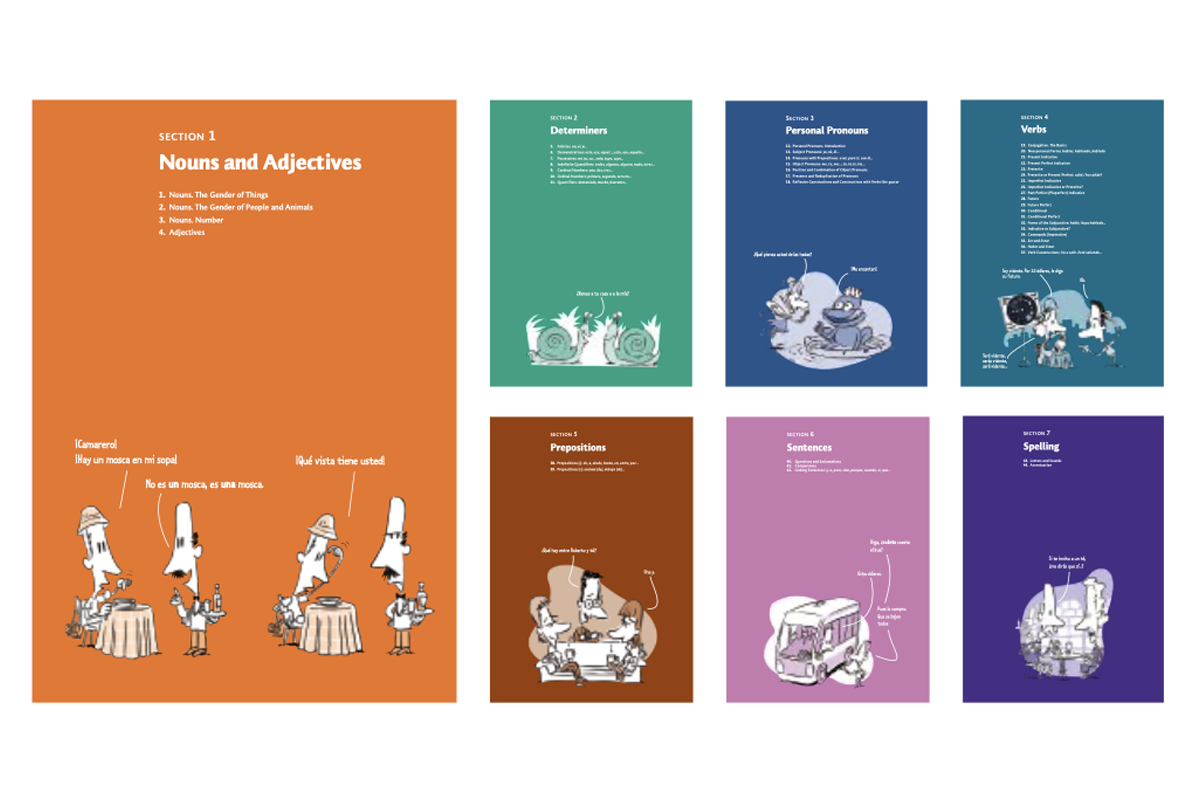
The book is organized into seven sections that cover the main aspects of the Spanish language’s grammatical system: nouns and adjectives; determiners; personal pronouns; verbs; prepositions; sentences; and spelling. These sections contain several chapters that combine explanations of grammatical structures (accompanied by abundant examples and illustrations) and exercises and activities, allowing learners to practice and easily check they have understood the previous explanations. These different units are interrelated, helped by comprehensive cross-referencing.
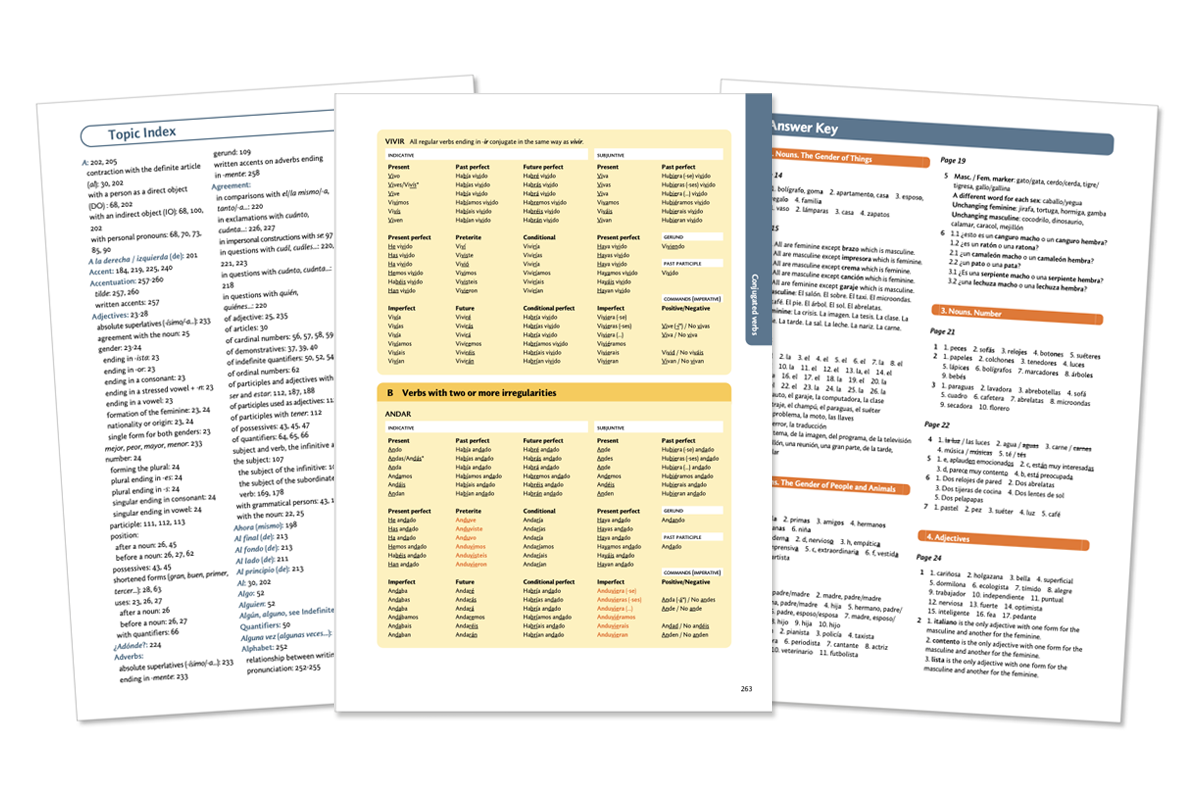
The GBE also provides an answer key, conjugated verb tables (where the learner will find the conjugations of regular verbs and an alphabetical list of the most common irregular verbs), and a topic index that facilitates the use and reference of different grammatical features.
GRAMMAR INSTRUCTIONS AND LANGUAGE EXAMPLES
The grammar instructions (with few technical terms and the vocabulary adapted to the level), diagrams, language examples accompanying the explanations, and illustrations have all been developed with the learner’s perspective in mind. We have considered the need for students to learn grammar while taking into account the systematic nature of the language, as well as the communicative value of the structures concerned.
EXERCISES AND ACTIVITIES
The GBE offers a wide range of activities and exercises that provide a great deal of practice involving interpretation and production, as well as correction of the mistakes that students commonly make at these levels. These have been designed and organized in such a way as to make the work interesting, enjoyable, and meaning-focused. They also have closed-ended questions so that students can monitor their own learning by checking the answer key at the back of the book. All practice provided in the GBE presents the language in authentic contexts, offering a fuller understanding of how Spanish grammar works.
The GBE is divided into seven parts covering the main aspects of the Spanish language’s grammatical system. Each part and its corresponding chapters are color-coded:
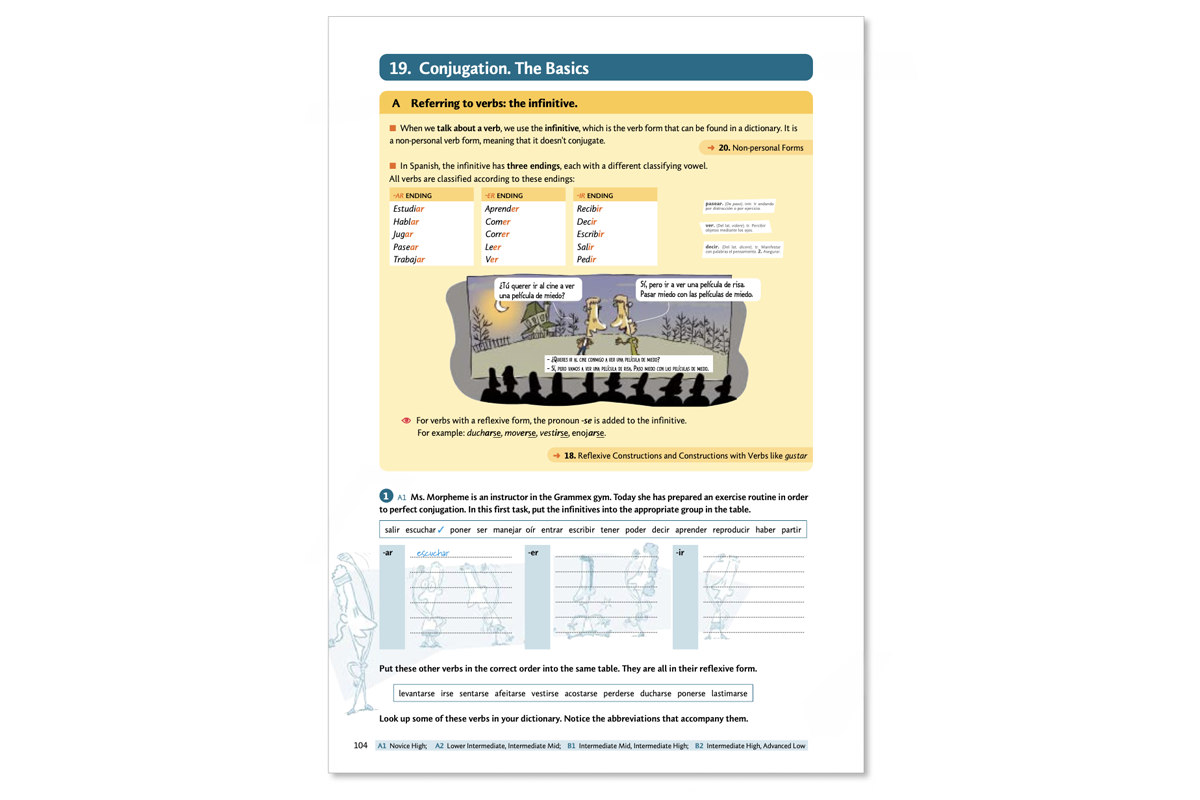
■ Chapters are organized into sections, in which explanations and exercises can be found:
Number and name of the chapter. The color shows you which part it belongs to.
Each section is indicated by a letter (A, B, C...) and provides explanations with examples and exercises. The sections are listed in the index.
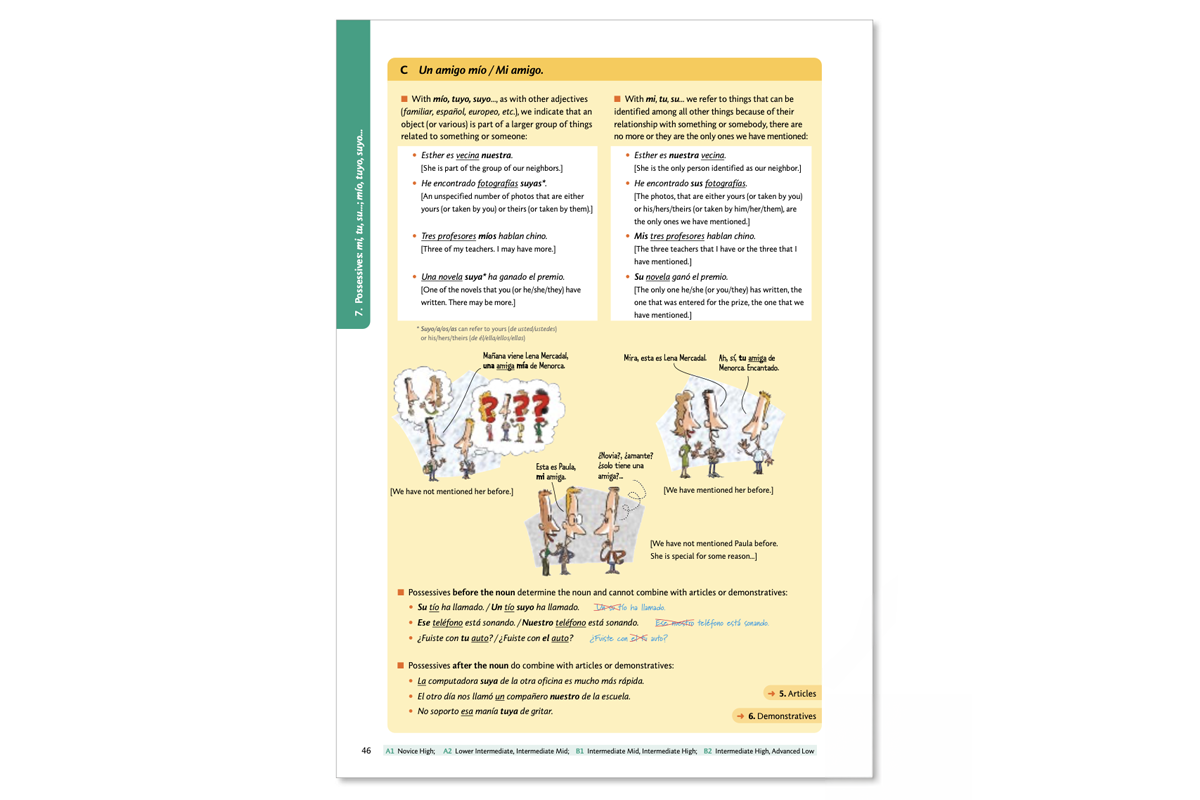
The explanations with examples are presented in boxes with a cream-colored background.
Following each explanation, there are exercises (both comprehension and production-based) so you can start to practice the structures that you are working on. You can check your own answers by consulting the answer key.
In the exercises, the grammatical forms are meaning-focused, so you should always pay close attention to the context and sense of the texts and sentences.
This symbol indicates the Common European Framework of Reference Level (A1, A2, B1, or B2) to which each exercise corresponds.
In every spread you will find the official correspondences between CEFR and ACTFL ratings.
The structures presented and the key concepts within the explanations are marked in bold.
Underlining is used to highlight elements directly related to the grammar point in question.
Explanations of the examples can be found within square brackets [...].
The white background is used to highlight important information: paradigms, forms, categories, classifications, etc.
Mistakes to be avoided are written in blue, with incorrect phrases crossed out in red.
Examples are written in italic and marked with this symbol •.
Cross-referencing to other chapters can be found in these boxes with the corresponding chapter number.
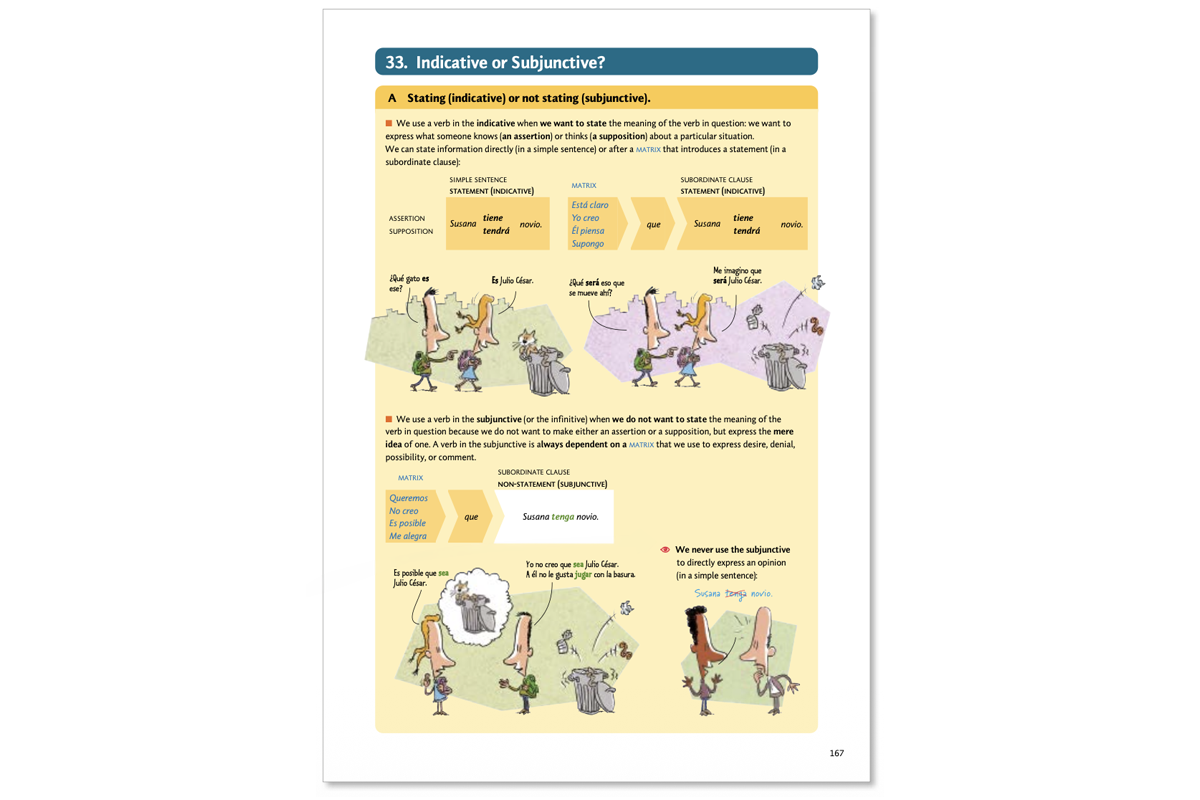
The most important information concerning the grammatical structures is marked by this symbol ■.
The illustrations, layout, colors, etc., are all designed to guarantee greater usability and promote the understanding and practice of all of the grammar guide’s contents.
Colors differentiate certain grammatical forms from others in order to facilitate understanding.
The 👁 highlights information you should pay particular attention to.
In addition to the chapters, this grammar also provides conjugated verb tables, an answer key, and a complete topic index:
The conjugated verb tables show conjugation models for regular verbs and the most common irregular ones. The stressed syllable is underlined. Irregularities are shown in orange.
Using the page, chapter, and exercise numbers as references, you can consult the answers in the answer key.
The topic index will help you easily find any subject covered in the grammar.
Gramática básica del estudiante de español. Versión panhispánica
Componentes

Componentes para docentes
Componentes para estudiantes
Gramática básica del estudiante de español. Versión panhispánica


Gramática básica del estudiante de español. Versión panhispánica
Te interesa también